Commercial
The Words Every Lighting Beginner Should Know Before Talking to a Designer
Walk into a lighting discussion unprepared, and it quickly becomes a blur of technical terms and confident recommendations. But once you understand the core concepts, everything becomes simpler and more importantly, you stay informed throughout the process.
This guide breaks down the most important lighting terms, so that when you sit down with a lighting designer or specifier, you know what questions to ask and what the answers actually mean.
Lumens: How Much Light You Are Actually Getting
Most people still think in watts. Watts measure energy consumption, not brightness. Lumens measure brightness. In modern LED lighting, a fitting can produce significantly more light while using far less power than older technology, which is why lumens is the figure that matters.
How many lumens a space needs depends on what it is used for and where it is located. The UK works to CIBSE guidance. The UAE references EN norms and local authority requirements. Both approaches are built around the same idea: different spaces have different needs, and those needs are defined, not guessed.
A lighting designer calculates the right output for the specific space, in the specific location, before anything is chosen. Lumens is where that calculation begins.
Lux: How Bright Your Space Actually Feels
Lumens measure what a fitting produces. Lux measures what reaches the surface, the desk, the counter, the floor. Two identical fittings in two different rooms can feel completely different depending on ceiling height, placement and beam angle. Lux is what professional lighting design is actually calculated around.
As a general reference:
- Office or task workspace: 300 to 500 lux
- Living room: 50 to 150 lux
- Retail environment: 500 to 1,000 lux and above
These figures shift depending on the standard applied in your location. A lighting designer confirms what applies to your project specifically.
If a room feels patchy, brighter in some areas than others, the issue is almost always layout rather than quantity. More fittings rarely solve it. Better placement does.
For a closer look at how lumens and lux work together, there is a dedicated article on how bright your space should be in the No Grey Area content hub.
Kelvin: The Colour That Defines the Mood
Lighting is not just about brightness. It is about how a space feels.
Kelvin (K) defines the colour temperature of light, the warmth or coolness of the light itself, independent of the shade or the finish of the fitting. It has a direct effect on ambience, and it is one of the decisions that most influences how a finished space is received.
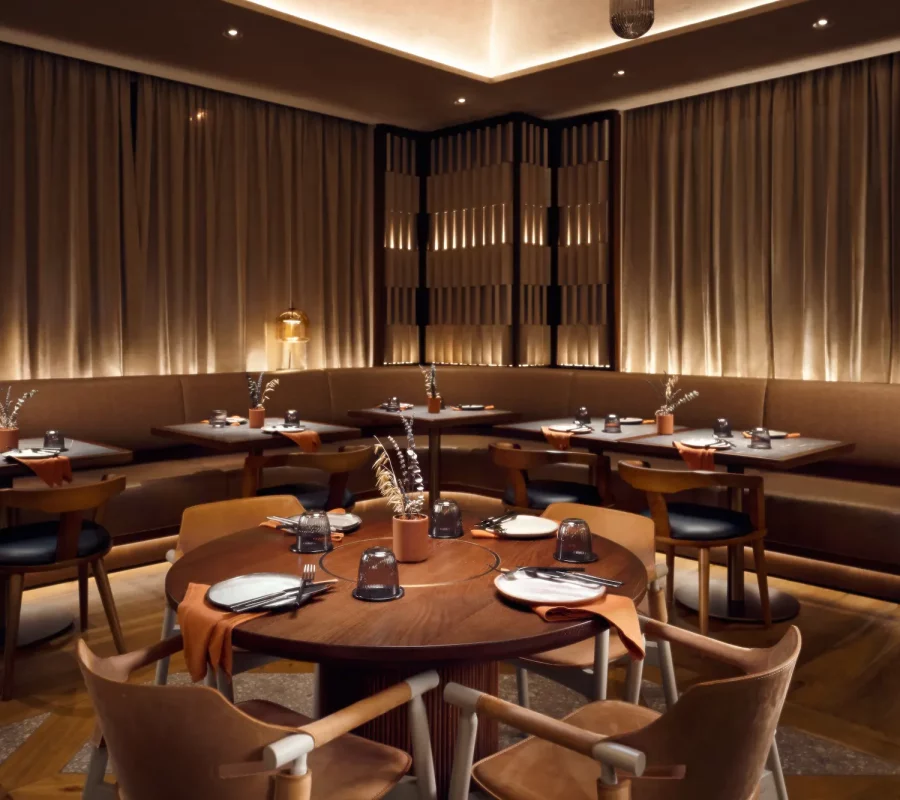
- 2,700K to 3,000K: Warm white. Soft and inviting. Suited to residential interiors, hotels, and restaurants.
- 3,500K to 4,000K: Neutral white. Balanced and clear. Suited to offices and commercial environments.
- 5,000K and above: Cool white. Sharp and alert. Suited to task-intensive environments such as clinical or industrial spaces.
A common mistake in residential and hospitality projects is specifying cool white lighting in spaces designed for relaxation. Even with a well-considered interior design, the wrong colour temperature can make a room feel clinical and uncomfortable. Your lighting designer will advise on the right Kelvin range for each zone and in many projects, that varies room by room.
CRI: Why Colours Look Right or Completely Wrong
Ever noticed how a fabric, a finish, or a paint colour looks different under artificial light than it did in the showroom? That is CRI at work.
CRI (Colour Rendering Index) measures how accurately a light source renders colours compared to natural daylight. The scale runs from 0 to 100.
- 90+ CRI: Colours appear true and vibrant
- 80 to 89 CRI: Acceptable for general commercial use
- Below 80 CRI: Colours appear flat or distorted
For most commercial and residential projects, a minimum of CRI 90 is advisable. In high-end retail, hospitality, and luxury interiors where the appearance of materials, finishes, and products is central to the brief, CRI 95 or above is increasingly the specified standard.
If your interiors feel flat or lifeless despite a strong design, switching to a higher CRI source can make a significant difference without changing a single fitting.
UGR: The Glare You Did Not Plan For
Good lighting should be invisible in the best sense. You notice the space, not the source. When that breaks down, glare is usually the reason.
UGR (Unified Glare Rating) measures how much a light source causes visual discomfort. The lower the number, the less glare. In professional specifications, office environments typically require a UGR of less than 19, a figure you will see referenced in lighting schedules and product data sheets.
Poor glare control leads to eye strain, headaches, and reduced concentration. It shows up most obviously when overhead lights reflect in screens, or when downlights feel uncomfortably bright even in a well-lit room.
Linear lighting systems and diffused fittings are frequently specified in workplace projects precisely because they manage glare effectively across large floor areas. If you are commissioning a workspace or any environment where people spend extended periods, UGR should be part of the conversation from the start.
IP Rating: Choosing the Right Light for the Right Environment
Not all lighting is built for all conditions.
IP rating (Ingress Protection) defines how resistant a fitting is to dust and water. The two digits in an IP rating indicate solid particle protection and liquid protection respectively, and specifying the wrong rating for an environment is both a safety risk and a warranty issue.
As a general guide:
- IP20: Suitable for dry indoor environments only
- IP44: Suitable for bathrooms (Zone 2) and similar damp environments
- IP65 and above: Required for outdoor use, wet rooms (Zone 1), and harsh environments
In the UK, bathroom lighting zones are defined under BS 7671, and compliance is not optional. If you are specifying lighting for external areas, swimming pools, or commercial kitchens, your designer will confirm the correct IP rating as part of the initial specification, not as an afterthought.
Modern lighting is not static. The most considered installations are designed to change with the time of day, the activity in the space, or simply the preference of the people in it.
DALI (Digital Addressable Lighting Interface) is the industry-standard protocol for intelligent lighting control. It allows individual fittings or zones to be dimmed, grouped, and programmed independently. DALI-2, the current iteration of the standard, offers greater interoperability between devices from different manufacturers and is increasingly the specified choice for commercial and high-specification residential projects.
What this means in practice:
- Different zones controlled independently from a single system
- Pre-set scenes for different uses such as presentations, relaxation or focused work
- Automated schedules that adjust throughout the day
- Integration with building management systems
Control solutions are most effective when they are designed into a project from the outset, not added at the end. If flexibility is important to how you intend to use a space, raise this with your designer at the briefing stage.
At No Grey Area, we work with architects, interior designers, and direct clients across residential, commercial, hospitality, and retail projects throughout the UK and internationally.
Our approach is collaborative from the outset. We translate the technical into the practical, and we make sure that every element of a lighting specification from output and colour temperature to control and compliance is aligned with what the space needs to achieve.
If you are in the early stages of a project and want to understand your options, get in touch with our team. We are happy to talk through the brief before any decisions are made.